
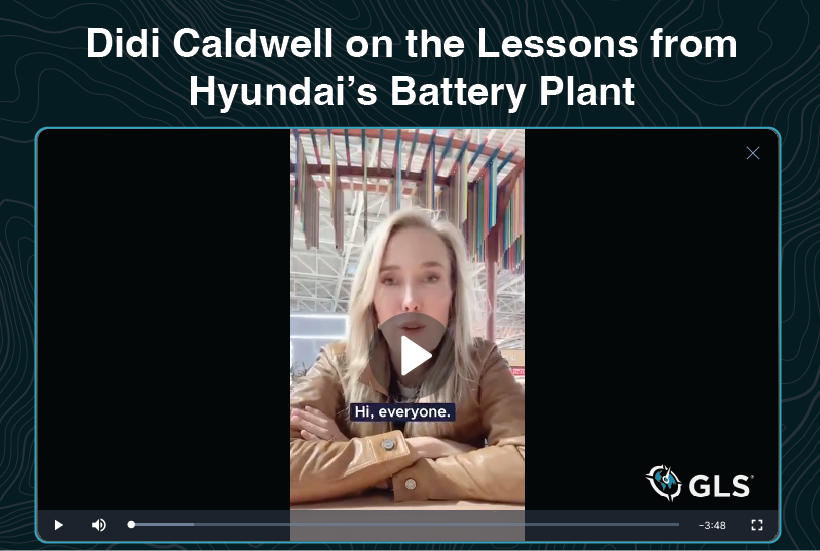
The recent ICE raid at Hyundai’s EV battery plant in Georgia has sent shockwaves through the global manufacturing community. At stake is more than just one project, it’s the question of whether the United States can be trusted as a reliable partner when foreign firms commit billions of dollars to new facilities.
Why Specialized Workers Come with FDI
When companies like Hyundai or LG expand into the U.S., they don’t just bring capital and equipment. They also bring teams of engineers and technicians from their “mother factories.” These experts commission the equipment, transfer critical institutional knowledge, and train local workers.
Without them, it is nearly impossible to bring a new facility online on time, on budget, and at the level of quality needed to compete globally.
For advanced industries like batteries, semiconductors, or life sciences, the process is not as simple as constructing a building and installing machines. The structure, piping, water treatment systems, and equipment are integral to the process itself.
Any deviation, even something as small as sourcing a slightly different raw material, can impact quality. That is why companies replicate facilities as closely as possible, following what’s known as a copy exact model. To do so, they rely on experienced workers who have designed, commissioned, and operated similar plants elsewhere
The Contradiction in U.S. Policy
According to Forbes reporting, some Korean workers at the Hyundai site were on B-1 business visas, which explicitly allow installation and after-sales service. It remains unclear how many fell into this category or whether any actual visa violations occurred, but the enforcement action caused delays and sowed mistrust.
Meanwhile, Hyundai has announced a $2.7 billion expansion at the same Georgia facility, aiming to reach production of half a million vehicles per year by 2028 and create thousands of jobs.
It is a striking vote of confidence, yet one that underscores the contradiction: while U.S. leaders travel abroad to encourage investment, domestic enforcement actions risk undermining that very message.
It is difficult to reconcile why the U.S. Department of Commerce and administration officials would push aggressively for new foreign investment while simultaneously creating obstacles for companies to get set up and succeed.
The Broader Impact on Trust
Imagine if the roles were reversed: a U.S. automaker builds a plant in South Korea, brings in American technicians, and local authorities raid the site to detain them. The U.S. government would almost certainly respond with diplomatic protests and calls for new protections abroad. That is exactly how South Korea views the Hyundai raid today.
For foreign investors, trust is everything. Without it, projects stall, costs rise, and companies begin looking elsewhere. And once investment momentum shifts, it is very difficult to recover.
Although U.S. labor will ultimately run these plants, the specialized expertise at the start is irreplaceable. No American has ever built this exact plant before. Every facility and every technology is unique. The only people who know how to do it are those who have already done it.
Once operational, American workers will be trained and knowledge will transfer—but that knowledge has to come from somewhere.
A Path Forward
The interests of all parties are aligned:
- The U.S. government wants high-quality jobs and global investment.
- Hyundai and LG want to operate profitable, efficient plants.
- Georgia and local communities want tax revenue and economic growth.
But alignment only works when trust is maintained. The solution lies in diplomacy and practical policy. Instead of dramatic raids, agencies could work with companies to address compliance issues while keeping projects on track.
The U.S. can restore confidence by:
- Clarifying visa categories for specialized technical workers
- Streamlining temporary permits tied to major investments
- Improving transparency in enforcement actions
- Encouraging open communication between governments and companies
If these steps are taken, America can continue to attract advanced manufacturing projects that create thousands of jobs, strengthen the balance of trade, and build trust with global partners. If not, the risk is that investment and the opportunities that come with it will move elsewhere.