
When it comes to location strategy, few data sources are as foundational as the U.S. Bureau of Labor Statistics (BLS). It might not be flashy, but its role in site selection and economic development can’t be overstated.
And in August that role was thrown into the spotlight in a way that should concern anyone involved in building resilient communities, guiding corporate investments, or shaping smart policy.
On August 9, the BLS released its July jobs report. The headline? Job growth was far weaker than expected—only 73,000 jobs added. Even more significant: the previous two months were revised down by a combined 258,000 jobs, the largest two-month revision since the early days of COVID-19.
Now, revisions like this aren’t unusual. BLS data comes from thousands of employers across the country, and not all of them report in time for the initial release. As more data comes in, the estimates get refined. That’s how statistics work. But this time, the reaction wasn’t routine.
Former President Trump responded by firing BLS Commissioner Erika McEntarfer, accusing her of manipulating the numbers. He claimed the data was being used “for political purposes” and labeled the report “RIGGED.”
Let’s be clear: accuracy in data comes from independence, not interference. Undermining the credibility of the BLS threatens the very foundation of our economic planning. And for those of us working in site selection, it hits particularly close to home.
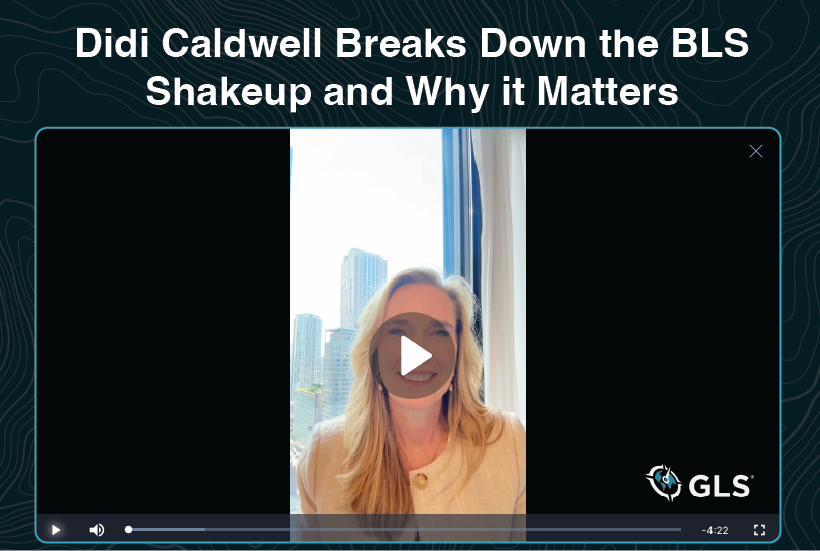
Why BLS Data Matters to Site Selection
The BLS doesn’t just tally job gains or losses. It provides granular, county-level data on:
- Employment by industry
- Occupational breakdowns
- Wage rates
- Workforce trends over time
- This data is the backbone of workforce analysis.
Let’s say a client needs to hire 50 skilled welders for a new manufacturing facility. At GLS, we look for a 50:1 ratio—ideally 2,500 qualified welders within a commutable distance.
We use this ratio to ensure the client can hire without inflating wages or draining the local labor pool. This level of insight is only possible through reliable, detailed labor market data—which is exactly what the BLS provides.
At Global Location Strategies, we use a platform called JobsEQ, which translates BLS and other public datasets into actionable insights. But the quality of those insights depends on the integrity of the source data.
And in the U.S., BLS labor statistics are widely considered the gold standard: comprehensive, consistent, and relatively unbiased.
That can’t be said for every country. In the EU, labor data collection varies by member state, making apples-to-apples comparisons difficult.
In autocratic regimes like Russia or China, labor statistics are often manipulated or suppressed altogether because they reveal uncomfortable economic truths.
The Real Risk of Politicizing Labor Data
Which brings us back to last Friday. The decision to remove the head of the BLS over a disappointing jobs report reveals a dangerous contradiction. On one hand, there’s a desire to project a strong economy. On the other, a weaker economy might support arguments for interest rate cuts.
But you can’t have it both ways.
Good data isn’t always flattering. It isn’t supposed to be. It reflects reality so decision-makers—whether they’re at the Fed, in the C-suite, or at a local chamber of commerce—can respond appropriately. If we start questioning the integrity of that data every time it delivers bad news, we lose the ability to plan with confidence.
For Site Selectors, It’s Not Just Inconvenient—It’s Dangerous
When trust in the data erodes, so does our ability to guide smart investment.
For site selectors, investors, and economic developers, this isn’t just a political moment. It’s a systemic threat. Our work depends on being able to assess risk, talent availability, and long-term labor cost dynamics. Without trusted data, the entire foundation starts to wobble.
And here’s the thing: The BLS doesn’t need to be reimagined. It needs to be protected. Because when we safeguard the independence of our data institutions, we safeguard the ability to build a future based on facts, not feelings.